Identity Mappings in Deep Residual Networks
Pre-activation ResNet design that enables training of 1000+ layer networks
Contents
Identity Mappings in Deep Residual Networks is the follow-up paper to ResNet. It asks a sharper question — why exactly do skip connections work, and can we make them work better? — and answers it with an improved design, the pre-activation ResNet, which enables training networks with over 1000 layers.
Read ResNet first. This page assumes you know what a residual block and a skip connection are.
Why Students Should Care
- This paper shows how a tiny architectural change — reordering ReLU and batch norm — can be the difference between a network that trains and one that does not.
- It gives the cleanest mathematical picture of why skip connections help, via a direct gradient formula.
- The lesson generalizes: keep the shortcut path as clean as possible. Modern architectures follow this principle.
The Problem with Original ResNet
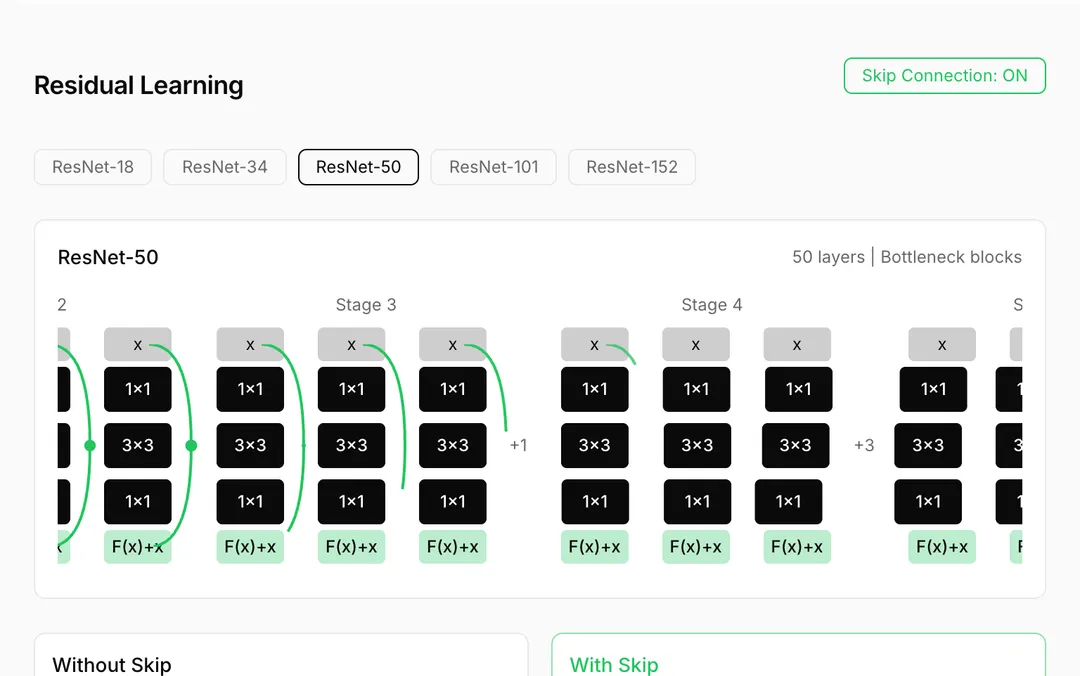
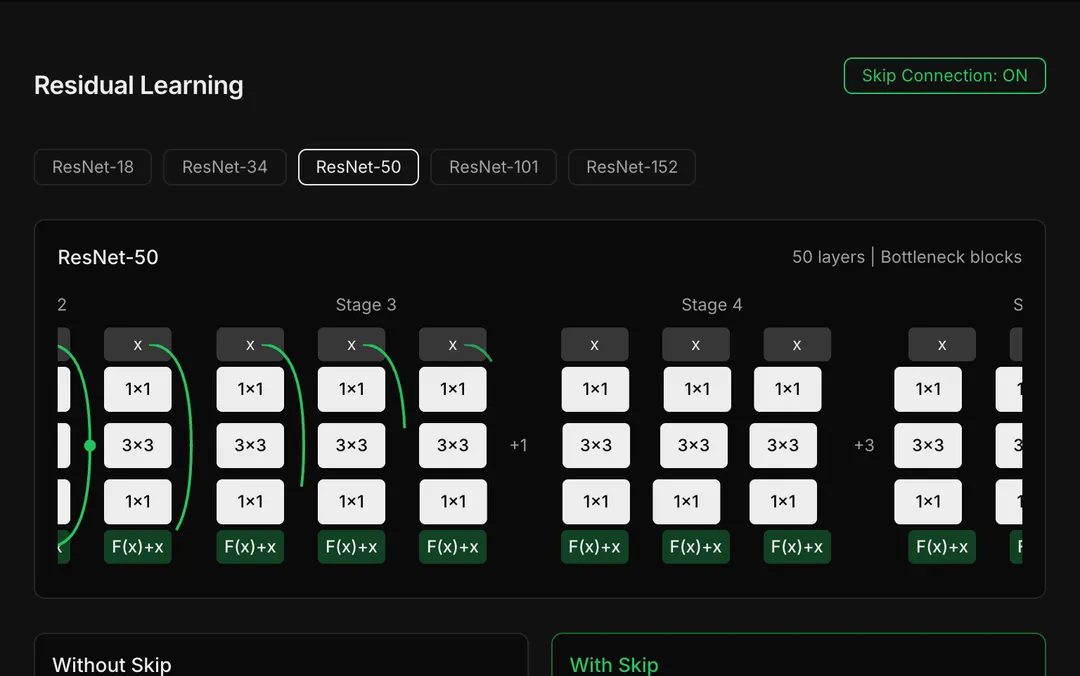
Think of a residual network as having two paths: a shortcut path (the identity) and a residual path (the layers). The whole benefit of ResNet comes from the shortcut being a clean, unobstructed highway.
But in the original ResNet, the block applies ReLU after the addition:
That means the shortcut path is not a pure identity — the signal passes through a nonlinearity at every block. Over hundreds of blocks, these small obstructions add up and can impede gradient flow in very deep networks.
Pure Identity Shortcuts
The key insight: for optimal gradient propagation, the shortcut should be a clean identity mapping — nothing on the highway at all:
Why does this matter? Apply the formula repeatedly and something nice happens — any deep layer is just the sum of a shallow layer plus all the residuals in between:
In plain English: layer 1000 can see layer 1 directly, with no nonlinearities in the way.
Pre-activation Design
How do you get pure identity shortcuts while keeping batch norm and ReLU? Move them before the convolution instead of after (hence “pre-activation”):
Same components, different order. This subtle rearrangement leaves the shortcut path completely clean and enables training of 1001-layer networks.
Interactive Demo
Compare the original post-activation design with the improved pre-activation version:
Identity Mappings in ResNets
Why Pre-activation Works
The gradient of the loss with respect to any layer :
You do not need to memorize this. The important part is the “1”: it means the gradient at any layer includes a direct, undiminished copy of the gradient from the top of the network, unimpeded by nonlinearities. Vanishing gradients cannot happen along the shortcut path.
Results
| Architecture | CIFAR-10 Error | CIFAR-100 Error |
|---|---|---|
| ResNet-110 (original) | 6.61% | - |
| ResNet-110 (pre-act) | 6.37% | - |
| ResNet-1001 (pre-act) | 4.92% | 22.71% |
Pre-activation enables training of networks 10× deeper with better performance.
Common Confusion
- This is a different paper from ResNet. ResNet (2015) introduced residual learning; this paper (2016, same authors) analyzed it and improved the block design.
- Post-activation vs. pre-activation refers to where ReLU and BN sit relative to the addition: after the addition in the original design, before the convolution in the improved one.
- Both designs use skip connections. The difference is whether the shortcut path is a pure identity (pre-activation) or passes through a ReLU (original).
Where To Go Next
- Read ResNet if you have not already — this paper builds directly on it
- Read Batch Normalization to understand the BN component being reordered here
- Read Transformer to see clean residual paths reused in modern architectures